
I’ve seen brilliant in-house teams and terrible ones.
I’ve seen brilliant outsourced models and terrible ones.
The key factor was never ownership, it was capability.
The honest answer to “should we build our own field team?” is almost always “it depends.”
That’s not a cop-out. The right answer genuinely turns on a handful of variables specific to your
business, and most of the advice you’ll get on the question comes from someone with skin in
the game.
Ask an outsourced agency and you’ll find, remarkably, that the answer is precisely the thing
they happen to sell. Ask the internal team and the right solution is often the one that expands
their headcount, remit, budget and scope. Neither is being dishonest exactly. People genuinely
believe in the model they’re closest to. However it does mean that most reviews of this question
are conducted by someone invested in a particular outcome and conducted while ignoring some
of the harder variables that don’t fit neatly on a spreadsheet.
So let’s try answer the question properly. Not to land on a universal answer (there isn’t one), but
to set out what should actually be considered and to be honest about the costs on both sides
that usually get left out.
The true cost of an in-house team
The case for in-house usually starts with a cost comparison. Take the outsourced rate, strip out
the agency margin, and the maths appears to favour building your own. On a spreadsheet, in-
house can look cheaper.
The problem is the spreadsheet rarely includes what it actually costs to run a team of people.
Recruitment. Onboarding. Training, initial and ongoing. The management layer required to run a
field force, and the time it absorbs. HR support, compliance and employment obligations. The
technology stack that an outsourced partner provides as standard but that you now have to
license, integrate and maintain yourself: visit management systems, reporting platforms,
expense portals, scheduling tools. Travel and fleet costs. Equipment. It all adds up.
And then the things that never make it onto any spreadsheet at all. The distraction cost of
running a large team of people, because people are hard. Turnover, performance management,
morale, the field crisis that pulls senior attention away from the commercial work it should be
doing. The opportunity cost of that attention is real and almost entirely unmodelled. How do you
put a line item on a spreadsheet for the strategic work your commercial leadership didn’t get to
because they were resolving a field team resourcing problem?
None of this means in-house is the wrong answer. It just means the in-house cost case is
almost always understated, because the genuine cost of running people is far higher than the
salary-plus-on-costs figure that usually anchors the comparison.
Once a team is in house a lot of people’s work is tied to running it, the team goes away and so
do some of these roles so the inertia can get baked in and take a major push and disruption
from above to change. Or as former PM Paul Keating put it ‘in a two horse race, always back
self interest….’
One thing I’ve learned over the years is that org structures become very good at justifying their
own existence.
Internal teams want to remain internal.
Outsourced providers want to stay outsourced.
Neither side is generally very objective.
The true cost of outsourcing
It would be convenient, having made that argument, to conclude that outsourcing is therefore
the obvious answer. It isn’t, and a piece that argued otherwise would be exactly the kind of self-
interested advice this article warned about.
Outsourcing looks like a clean transfer of cost, time and effort to a partner. In reality, a
successful outsourced model is never quite that clean.
Beyond the hourly rate, there’s integration: connecting the partner’s systems, processes and
reporting to yours. Knowledge transfer, which is never a one-off; it’s ongoing as products,
priorities and people change on both sides. Third-party management, because an outsourced
team still needs to be directed, briefed and held to account, and that requires an internal owner.
The internal coordination required to feed a partner the information they need to execute well,
because a field partner is only as good as the brief and the data they’re given. Dependency risk,
the exposure that comes from a critical capability sitting outside your own walls. A potential loss
of speed and agility, particularly where something falls outside the agreed scope. And, of
course, the partner’s margin, because no one works for free, and nor should they.
A good outsourced relationship absorbs most of these costs comfortably and still comes out
ahead. A poorly managed one can cost more than the in-house model it replaced, while
delivering less. The hourly rate is the easy part of the outsourcing decision to evaluate. The
harder part is whether you have the internal capability to manage the relationship well enough to
realise the value.
The decision variables that actually matter
If neither cost case is as clean as it first appears, what should actually drive the decision? Four
variables matter more than the rest.
Scale and predictability
A field program that is large, predictable and stable, with consistent call frequencies, a
settled store list and year-round activity, leans toward in-house. At that scale, the fixed cost of
building and running a team is spread efficiently and the control benefits are real. A requirement
that is variable, seasonal or spiky, heavy in some periods and light in others, leans toward
outsourced, where you can flex capacity up and down without carrying the cost of a standing
team through the quiet periods.
Channel complexity
This one runs slightly counter to intuition. The more complex and multi-channel the requirement,
with grocery, independents, pharmacy and hardware each demanding different capabilities,
relationships and ways of working, the more an outsourced solution tends to be favoured.
Building and maintaining genuine capability across multiple distinct channels in-house is
expensive and hard; a partner who already operates across those channels carries that
capability as standard. The exception is where channel complexity is paired with high strategic
value and deep proprietary knowledge, in which case the calculation shifts back toward
ownership.
Speed to capability
Outsourced models activate faster. A partner can have a team in the field in weeks; building the
equivalent in-house capability takes months and sometimes longer. If speed matters, whether
for a launch, a market entry or a competitive response, that favours outsourcing. The qualifier is
complexity again: the more complex the channel and the more specialised the information
required to operate in it, the longer a partner takes to get genuinely effective, which narrows the
speed advantage and makes in-house look more attractive over a longer horizon.
Is field execution a competitive advantage
This is the variable most often skipped and arguably the most important. Is field execution a
core differentiator for your business, something you compete on, a strategic asset? Or is it an
executional necessity, something that needs to be done well but isn’t where your competitive
advantage lives?
If field is genuinely strategic, the case for owning it is stronger; you want the capability, the data
and the relationships inside your own business. If it’s executional, outsourcing to someone who
does it for a living is usually the better use of capital and attention.
The hybrid model
In practice, the answer for a growing number of businesses isn’t in-house or outsourced. It’s
both.
The hybrid model has become more common. The shape varies but the logic is consistent: keep
an in-house management layer and a core in-house team focused on the activities that are
deemed to be high value, critical, complex or strategically important. The channels and tasks
where ownership, continuity and proprietary knowledge genuinely matter. Outsource the simpler
executional channels and the more variable work to a partner who can deliver it efficiently and
flex with demand.
Done well, this captures the best of both. You retain control and capability where it counts and
buy flexibility and efficiency where it doesn’t. Done badly, it doubles your management
overhead and blurs accountability across two models that don’t quite join up. The difference is
almost always in the clarity of the split: being genuinely clear about which work belongs where,
and why.
Some businesses outsource because they acknowledge they lack the capability to excel in field.
Others outsource because they understand exactly what capability they need and where it
comes from.
Many large sophisticated FMCG organisations deliberately choose to outsource not because
they cant do it themselves but because they recognise the benefits of scale, flexibility, channel
expertise, technology and training. That’s an important distinction.
The capability flywheel
Strong field execution capability comes from complementary capabilities supporting success.
Get these areas right and a field team can make a major impact on performance. Get them
wrong and the same is true in reverse.
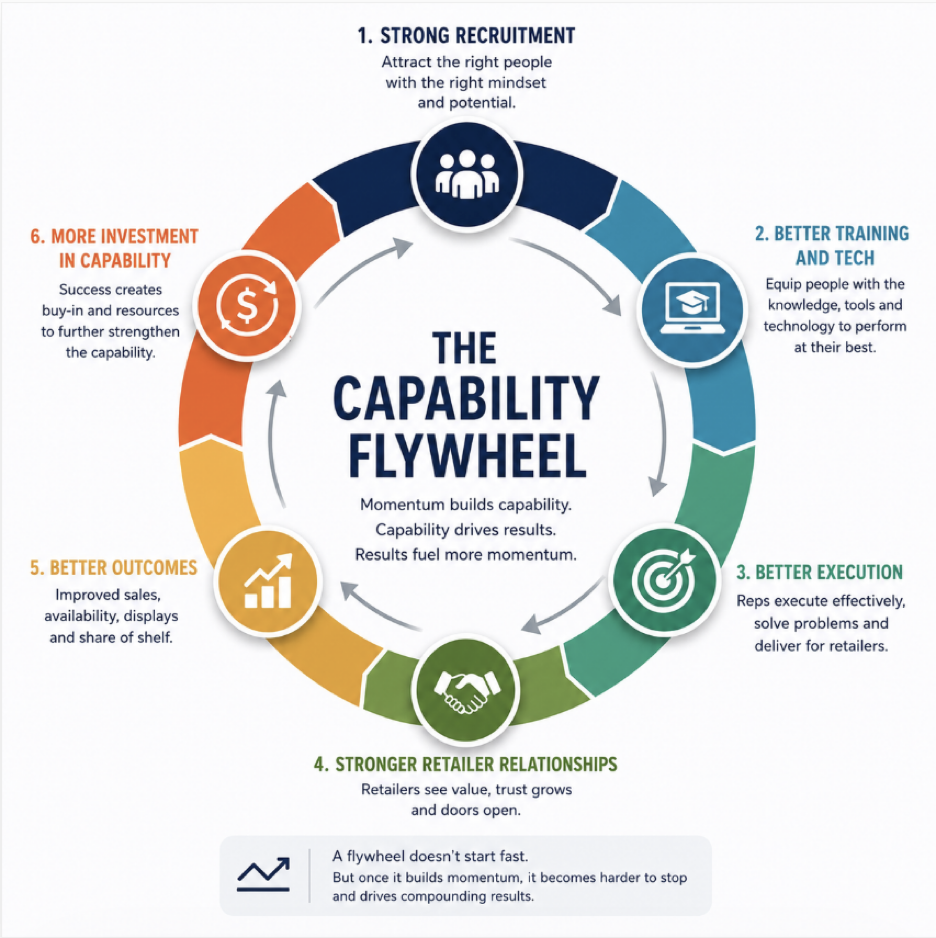
One of the biggest mistakes businesses can make is assuming that because they already
manage a sales team then they can also manage field teams equally as well. It’s a specialised
operational capability in its own right and should be treated as such.
Whether those capabilities sit inside your business or inside a partner is secondary. What
matters is whether they exist.
The retailer doesn’t really care about who employs the rep. They care the shelf is full, displays
are built, POS is in place and issues get solved.
That’s always worth remembering when discussions start to get dominated by org design and
cost comparisons. The most important question isn’t if the team sits inside or outside of a
business, it’s have you built the right capability to win in store.