
Compliance matters.
A shelf that’s wrong needs to be fixed. A planogram that’s drifting needs to be corrected. An OSA problem needs to be resolved. None of that is optional and none of it is being argued away here.
But compliance is the table stakes. It’s the entry requirement for a field team, not the win. A team that achieves perfect compliance and nothing else has done the minimum the retailer expects not what the brand is paying for.
The reps who move the needle aren’t the ones with the highest visit scores. They’re the ones who walked into a store with an objective, had a conversation that mattered, and left something better than they found.
If a call isn’t influencing sales, what is it really there for?
When I first started in field marketing, reps recorded store visits on paper and posted the results back. Call cards, handwritten notes, compliance sheets filled out in the car park before driving to the next store. At the end of the week they went into the post. Somewhere in an office, someone collated them and data-entered them into a spreadsheet. By the time the information reached anyone who could act on it, it was already too old to be meaningful.
The industry looked at that problem and decided the answer was speed. Phone in at the end of the day to a data entry team. Then mobile devices. Then apps. Then platforms with real-time dashboards, image recognition, geo-tagged visit verification and automated compliance scoring. Each step was a genuine improvement in visibility. And somewhere along the way, almost without anyone noticing, the job changed.
Not the job title. What reps actually do with their time once they’re inside a store. The shift wasn’t planned and it wasn’t sudden. It was just the logical consequence of measuring and incentivising the wrong things.
The result is a field call where 75% of the time can be spent documenting the store situation and only 25% influencing it. A rep recording competitor activity, photographing shelf conditions, logging out-of-stocks, spending time in the back room, uploading everything to the platform and then having a two-minute conversation with the store manager on the way out.
That’s not a field sales call. It’s an audit with a brief social component at the end.
Two visits to the same store
Consider two versions of a field visit to the same store on the same day. Same rep. Same products. Same store:
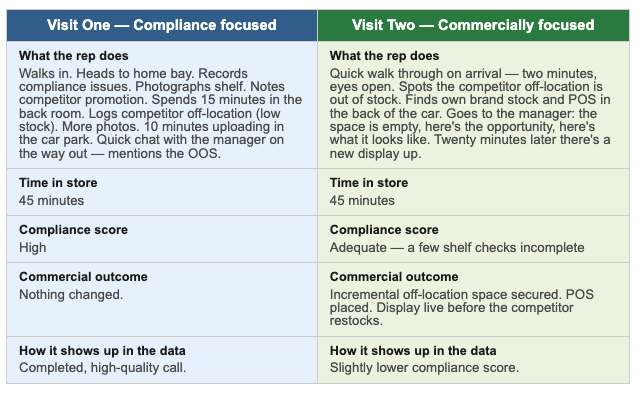
Which was the more valuable call? The answer is obvious. The way most field teams are measured doesn’t reflect it.
The commercial rep spectrum
The difference between those two visits isn’t talent. It’s direction, what the rep believes the job is, what they’re measured on, what they’ve been trained to do, and what they’re incentivised on. Most field reps sit somewhere on a spectrum between two extremes. At one end is the Documenter. At the other is the Commercial Operator. In between are two stages that represent where most teams currently sit and in my view, where the biggest opportunity for improvement lies.
The Documenter‘s job is to record and report the store situation. Visits are structured around data capture, shelf compliance, competitor activity, stock levels, promotional set-up. The output is visibility: accurate, timely information about what the store looks like. This is valuable. But it’s the base, not the ceiling.
The Resolver goes further. They don’t just photograph the wrong planogram they fix it. They don’t just log the out-of-stock they pull the stock from the back room. Same store, same visit, meaningfully different outcome. The capability required is product and category knowledge plus the confidence to act without being explicitly told to.
The Influencer is having conversations that weren’t on the call plan. They’ve spotted that the competitor’s promotion ends this week and they’re asking the manager about the space. Sometimes they get a yes. Those yeses add up. Displays that weren’t in the plan, facings extended, POS placed because someone asked.
The Commercial Operator runs every store relationship as a portfolio. They arrive with a prepared objective, a specific ask, and a commercial argument that works for the store as well as the brand. They understand the store’s priorities, identify the overlap with their own, and make proposals that work for both. This is the rep who consistently delivers above what’s agreed because they understand that execution is where the brief ends and the real job begins.
The best reps understand something many brands forget. Store managers don’t wake up thinking about your compliance score. They’re thinking about sales, labour, availability and customer experience.
Commercial conversations work when they solve a store problem, not just a brand problem.
Most field teams have most of their reps sitting between Documenter and Resolver and assume that’s the job done. The commercial value difference between that and operating between Influencer and Commercial Operator is significant and it’s almost entirely invisible in standard compliance reporting.
What automation frees field teams to do
Here’s where the conversation about technology gets more interesting.
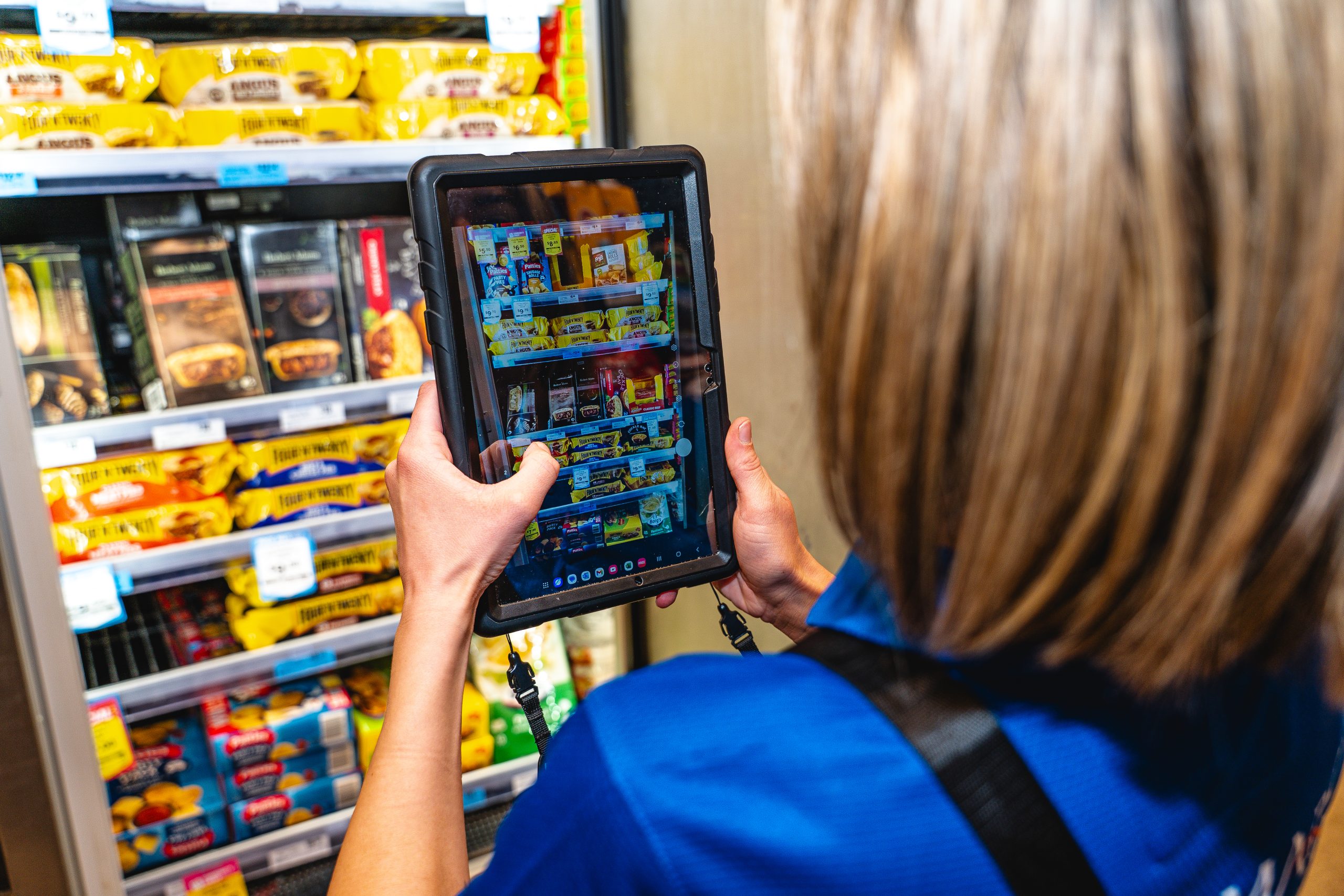
Image recognition is getting genuinely good. Basic shelf compliance, planogram adherence, out-of-stock detection, share of shelf measurement can all increasingly be handled through a photograph / video analysed by a model rather than a rep manually recording every SKU. Visit prioritisation is becoming data-driven, with systems that identify which stores have the highest commercial opportunity or compliance risk on a given day. Reporting that used to take twenty minutes of a call is being compressed to seconds.
This is genuinely freeing up time in the field. The question is what that time gets redirected to.
For most businesses the honest answer is: not much yet. The time saving gets absorbed into more stores per day and marginally better coverage. The efficiency gain is real but it’s being taken as productivity rather than redirected as capability.
The businesses that will extract the most value from AI in the field are those that deliberately redirect the time saving toward commercial activity. Fewer visits that are deeper and more influential rather than more visits that are faster and more documented. Reps who arrive at a store already knowing (because the data told them) that there’s a secondary placement opportunity, that the competitor’s promotional programme ends this week, that this store’s rate of sale on their lead SKU has been climbing and the manager might be ready for a ranging
conversation.
The dual benefit is real. Reps enabled by specific, actionable data to know where to spend their time and what the opportunity is in each store. Managers getting the visibility, measurability and transparency they need to run the team. And ultimately a better ROI from field investment and improved sales not because the team is working harder, but because they’re working on the right things.
That’s not a technology story. It’s a management and capability story that technology makes possible.
Building a commercially capable field team
If most field teams are oriented too far toward documentation and not far enough toward commercial influence, the next question is what to do about it. In my experience, three things have to change.
Measure commercial outcomes, not just activity. A rep who secures an off-location display, extends a facing, or gets a new line ranging in an independent store has done something commercially valuable. In most field team measurement frameworks, that outcome either isn’t captured at all or carries the same weight as a completed store report. Until measurement reflects commercial outcomes rather than just activity completion, the incentive to focus on commercial activity simply doesn’t exist. You get what you measure and a lot of businesses are measuring the wrong things.
Invest in influencing capability, not just product knowledge. Most field reps receive thorough product training. They know the range, the promotional mechanics, the planogram, the POS requirements. What’s almost always missing is how to have a commercial conversation. How do you identify what a store manager actually needs? How do you frame a proposal that works for the store, not just the brand? How do you handle an objection and close on an ask? These are learnable selling skills and the gap between a rep who has them and one who doesn’t is not small.
Manage commercial behaviour, not compliance scores. A field manager who spends their one-to-ones reviewing visit completion rates and reporting quality is reinforcing the Documenter orientation. A manager who asks ‘what commercial conversations did you have this week and what came out of them?’ is reinforcing something different. The management conversation shapes what reps believe the job actually is more than any KPI framework or training programme on its own.
That’s the job, driving sales. The reporting matters, the outcome matters more.
Where does your field team sit on the spectrum? If most of your visits are closer to documented than commercial, the ceiling on your field ROI is lower than it needs to be.