
‘Smart’ and ‘AI’ are two of the most visible examples with both appearing across CE retailer catalogues. Both can describe real functionality. Both can also be stretched into shorthand when brands are trying to simplify a more complicated product story – but they are not doing the same job.
This is based on CROSSMARK analysis of catalogue data from physical retailers. We compared the presence of ‘Smart’ and ‘AI’ labelling across product categories, brands, and price. The aim was to understand how these terms are being used in-market to shape shopper perception, pricing, and brand positioning.
The analysis should be read as a retail and positioning view from the outside as surely there are nuances as to the decisions these brands have made whether voluntarily or not. This is what the shopper sees in catalogues, on shelf, and in product comparison moments.
That matters in CE because the purchase journey is rarely linear. Australian shoppers increasingly move between online research, retailer websites, catalogues, stores and mobile comparison before making a decision. Google and Kantar research found that 88% of Australian retail sales take place in-store, but only 12% of those in-store sales had no digital influence. The same research found that 70% of Australians use their phone for something purchase-related while they are still standing in the store.
In CE, that makes language work hard. A label has to be clear enough for a catalogue, credible enough for a product page and practical enough for a rep to explain at the demo unit.
1. Smart and AI are growing, but they are doing different jobs
‘Smart’ is the more established label and in most CE categories, usually points to connectivity and the benefit is usually convenience with Wi-Fi, Bluetooth, app control, remote operation, voice assistant compatibility or phone-based monitoring.
- A smart kettle to boil water from the couch
- A smart garage opener via an app
- A smart TV to have built in streaming apps
‘AI’ is growing from a smaller base, but with a different job. It is more likely to point to processing, recognition, optimisation or adaptation and the benefit is usually performance:
- An AI TV may be positioned around image processing or upscaling.
- An AI robot vacuum may use obstacle recognition or mapping.
- An AI hair tool may adjust temperature or airflow through sensors.
- An AI PC may focus on productivity features, local processing, or dedicated AI hardware.
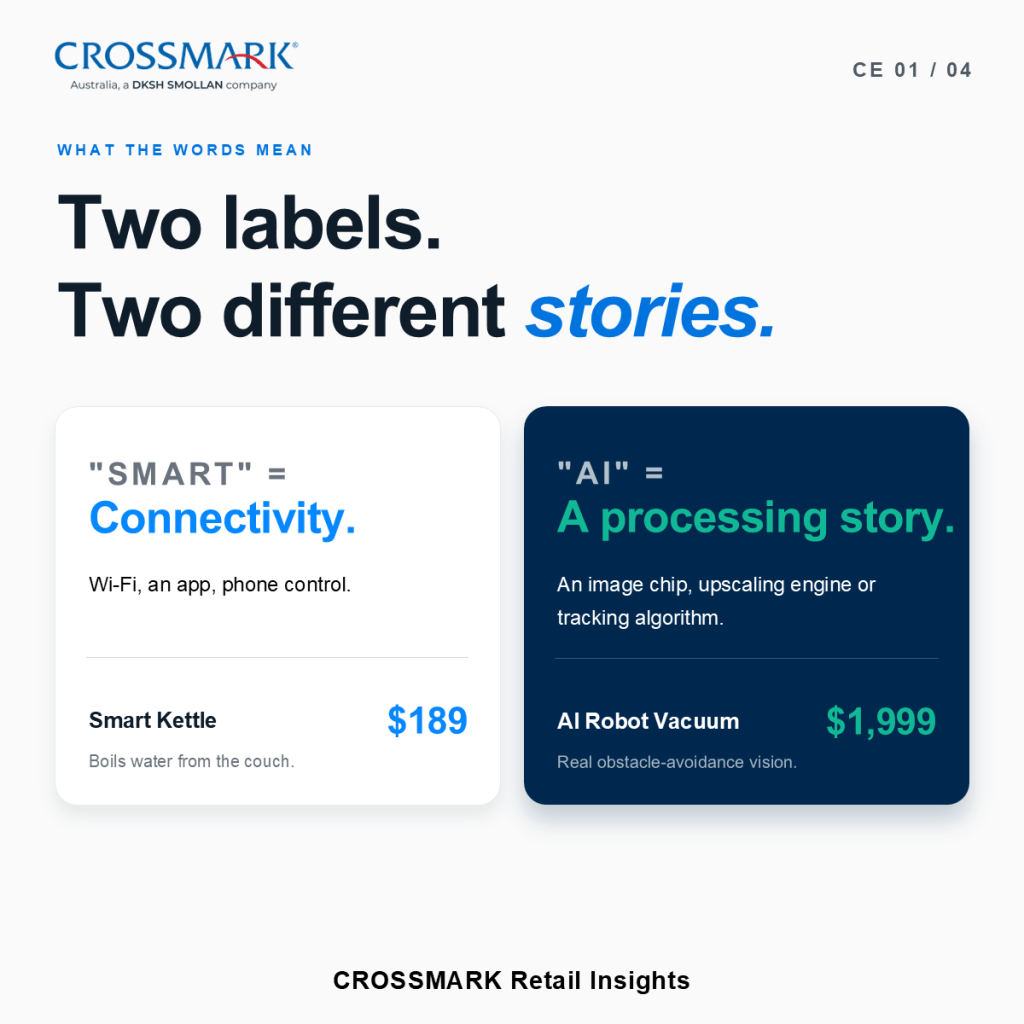
AI can be harder to evaluate vs. the established ‘Smart’. The shopper has to understand what the product is doing differently and whether that difference is worth paying for.
What the labels actually signal to shoppers
The catalogue data shows that Smart and AI are parallel strategies rather than interchangeable claims. AI tends to signal that the product is doing some kind of processing or decision-making. It implies the product can recognise, optimise, adjust or enhance performance with less manual input from the user.
Some AI claims appear to be attached to genuinely meaningful product features, such as object-recognition in robot vacuums, image processing in TVs or AI-enabled productivity in PCs. Other claims are harder for shoppers to verify, especially when the difference between “automated”, “sensor-based” and “AI-powered” is not clearly explained.
That is where retail execution becomes important as in CE, the shopper often arrives with a shortlist. They may have seen the catalogue, compared prices online, and checked retailer product pages. The final decision can still depend on the in-store conversation with the brand’s ambassador or retail sales associate: what the feature does, whether it matters for their use case, and why one product is worth more than the next.
2. The label tax: AI commands a premium, Smart has become baseline
The clearest finding in the catalogue data is the price difference.
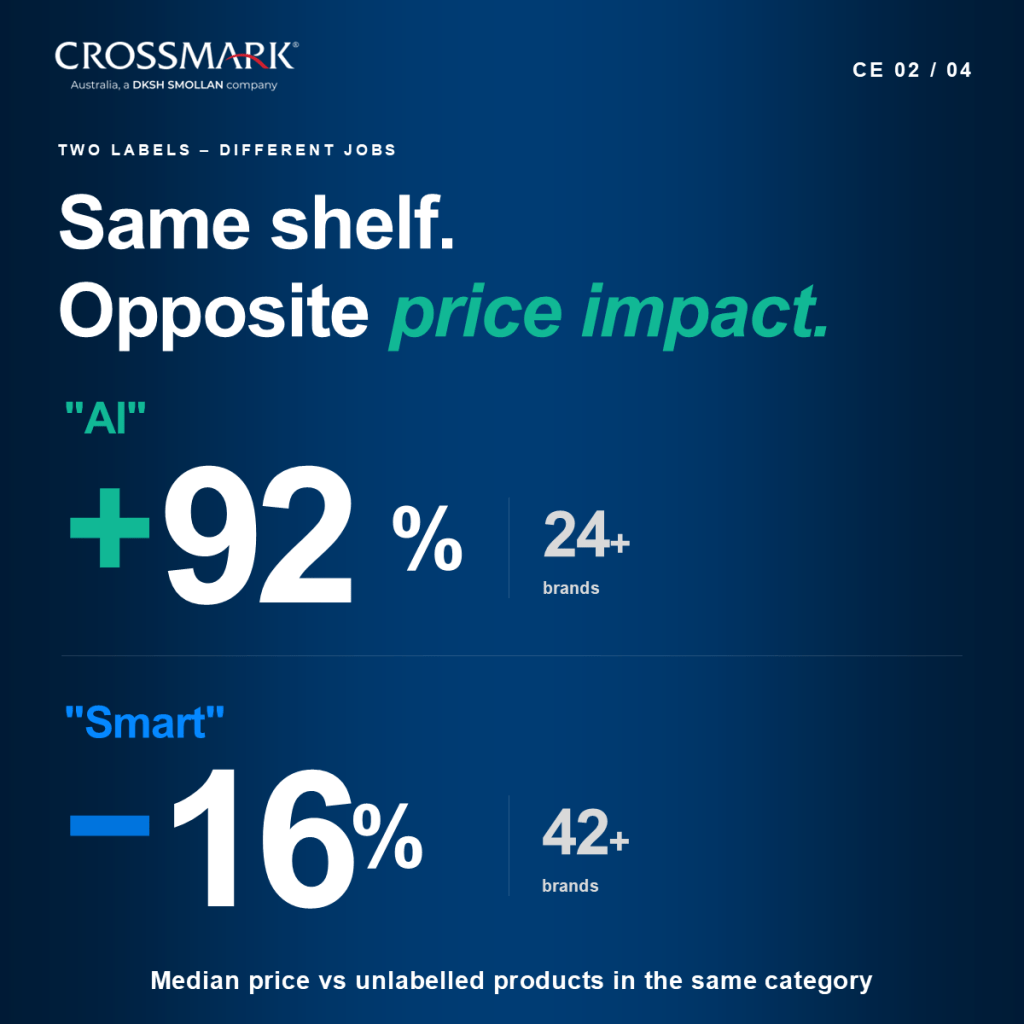
AI-labelled products carry a +92% median premium over unlabelled products in the same category.
Smart-labelled products sit at a -16% median discount.
While it doesn’t not mean every AI-labelled product is better and every Smart-labelled product is low value, it does show AI is being used to support a higher price position. Smart is more often sitting in accessible, mainstream or value-led parts of the range.
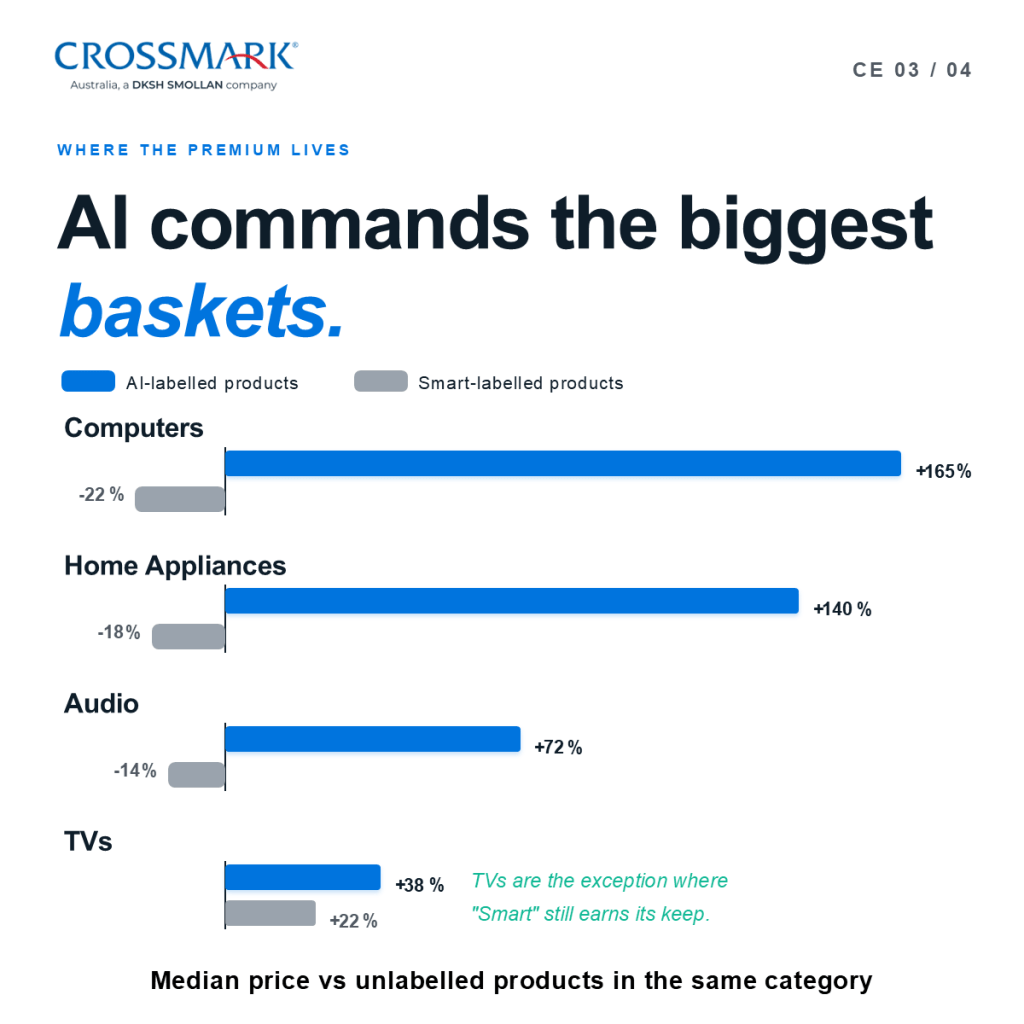
TVs are a partial exception. “Smart” still matters because the smart platform is central to how the shopper uses the product: streaming apps, content discovery, operating system, remote control and interface. In that category, Smart is not just a technical add-on. It is part of the everyday experience.
NielsenIQ expecting global consumer tech market to be broadly flat in 2026, with value-for-money, saturation and regional differences shaping demand, while consumers continue trading up in selected areas where connected living and premium features are compelling. That creates a sharper test for AI claims in a value-conscious environment, shoppers may accept a premium, but only when the benefit is clear.
3. The positioning tell: most premium brands are staying silent
Most premium brands are often less reliant on ‘Smart’ and ‘AI’ language. In the catalogue data, brands such as Sony, Dyson, Apple, and Lenovo appear to lean more heavily on brand equity, product experience, ecosystem strength and category authority.
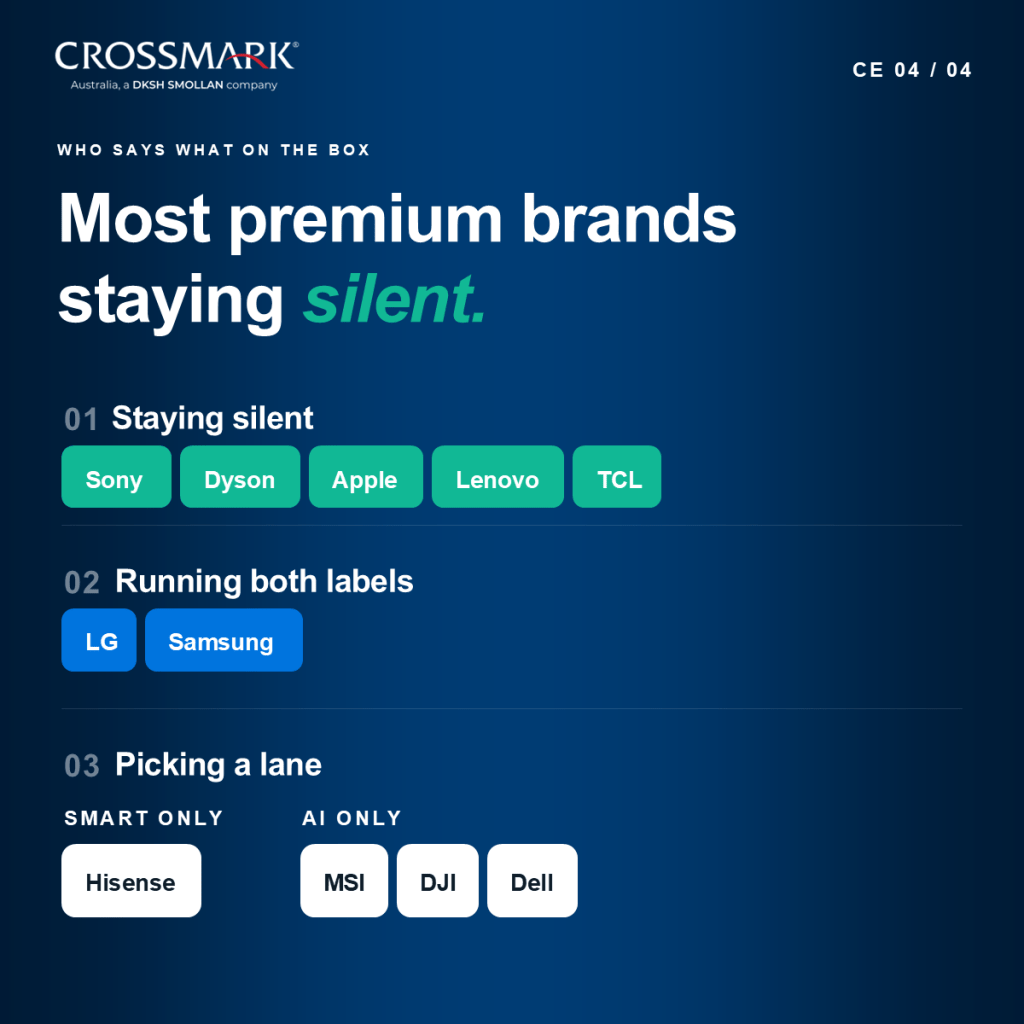
Mid-tier and value-positioned brands are more likely to use Smart or AI as explicit positioning tools.
- Some brands use both labels across different parts of the range.
- Some lean heavily into Smart and barely use AI.
- Some use AI selectively in categories where the premium is easier to defend.
- Others appear to avoid both labels almost entirely.
This does not make one approach better than the other. It depends on the role of the brand, the maturity of the category and the shopper’s ability to understand the claim. Perhaps for premium brands, saying less can be a strength with the brand itself already signalling quality, design, or performance. For mid-tier brands, the label could help create a reason to believe and make a product feel more current or justify a step-up price.
Stay informed and in touch
At CROSSMARK, we work with a broad mix of retail data, field intelligence, and category experience across the business. That gives us a practical view of what is happening in-store, online, across catalogues and at the point of decision, helping us shape better strategies and deliver stronger outcomes for our clients.
This article is part of a new insights series where we’ll be sharing different reads on channels, categories, and shopper behaviour throughout the year. If you’d like these sent straight to your inbox, you can sign up to the CROSSMARK newsletter. And if anything here sparks a thought, challenge or opportunity for your brand, please feel free to reach out.
Explore this issue further
Consumer Electronics is a channel where brand activation can make a big difference. Learn more about CROSSMARK’s Consumer Electronics channel capability, and how our Merchandising and Brand Ambassador teams help brands turn strategy into stronger in-store execution.