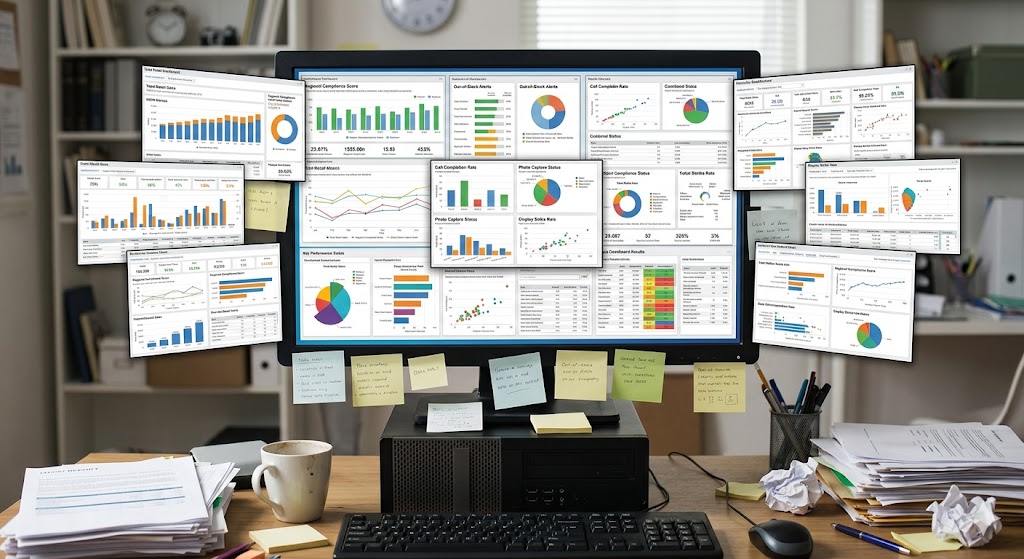
FMCG businesses have never had more visibility of their store estate, and yet in many cases, execution has never been flatter.
That’s not a coincidence; it’s a structural problem. The more data we are able to collect (and tech is accelerating this at a rate of knots) the more dashboards get created, the more metrics get added to scorecards, more detailed store-specific reporting – but still execution is flat.
Investment is made in time and resource to create greater visibility of the retail landscape. Data isn’t the problem; it’s what is then done with it that creates the issue.
Data without direction is noise
Often much of the data collected fails to drive action for a number of reasons. Too much of it so the intention is lost, wrong cadence so it’s not timely, no ownership of an outcome, no feedback loop back to the field, flags that can’t be acted on, OSA alerts days late or buried in a weekly report. Quite often data is collected because someone thinks it would be interesting rather than because it generates an actionable outcome.
Visibility and execution are not the same thing
Visibility – what you can see in a store – is one thing. Execution – what you can influence in-store – is something different. The gap between the two is the distance between data and behaviour. Lots of variables can create this gap: capacity constraints, unclear prioritisation, lack of accountability, and field teams focused on collection of data rather than problem solving. How and who drives the field team’s objectives in your business – and what are they (and the team) measured on?
What you’re measuring for could be driving the wrong outcomes
People optimise for what they are measured on. This is a classic example of Goodhart’s Law:
“When a measure becomes a target, it ceases to be a good measure.”
Most field team KPI frameworks are a case study in this. Compliance rates, call completion, photo capture, display strike rates – all started as useful proxies for commercial outcomes. Over time, many businesses begin managing the metric rather than the outcome it was designed to protect. The incentive structure followed, and the job becomes about driving the metric, not changing the store.
For example, if a team is incentivised and measured on gaining off-location displays, the team will focus heavily on this. But what if that’s at the expense of OSA on the home bay as it depletes stock levels – will it drive sales? In some cases it might, but in lots of instances it won’t. The team hit their numbers, get their bonus, targets met, metrics are going up – high fives all round for a job well done, but sales flat. Or how often have you received detailed breakdowns of compliance on promotional activity after it’s already ended and nothing can be done about it?
Tech and AI are accelerating the problem
Now more data can be collected even quicker, more metrics get added to dashboards. This can simply amplify the problem. Generating more measures, more alerts, more data points doesn’t help if the field team can’t act on what already exists. Interpreting the data, parsing the information, and filtering the signal from the noise is becoming more important than ever. When it comes to data collection in the field, the phrase “just because you can doesn’t mean you should” has never been more relevant.
Data to action: the infrastructure that matters
Spending the time and resource to work on the data-to-action infrastructure for field teams is more important than ever. Rationalise the measures a team collects to those that are genuinely aligned with the goal of the team. Be explicit and clear about the role of each measurement – what are we doing with this data? What improvement is it driving? What action are we going to take? Technology is a fantastic enabler for field teams – AI-driven image recognition and data models provide a richness of information we could only dream of a few years ago – but its value always comes back to what you’re doing with it.
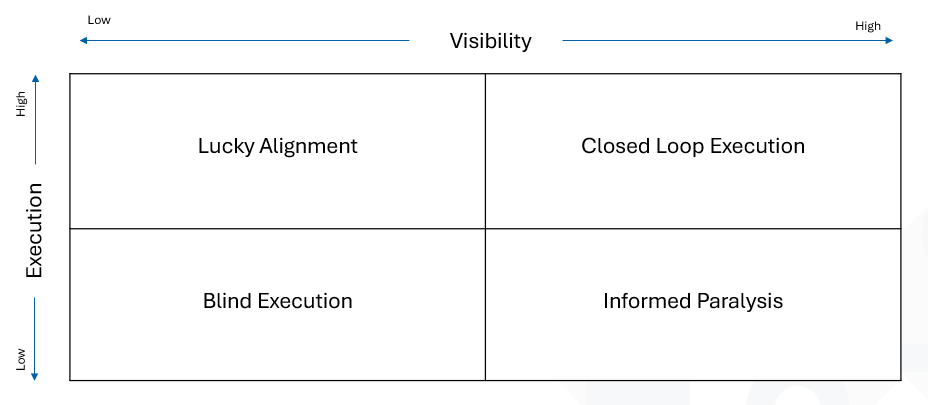
Where do you sit?
How does your team perform in this space? Place yourself honestly in the matrix – visibility on one axis, execution on the other. And what are some simple steps to help improve?
- Can you name the three metrics that are most important to the team and clearly draw a line to their commercial impact?
- Are the measures and incentives aligned to the overall business goals?
- How much of your reporting and dashboards actually get reviewed regularly, outside of the field team?
- Does every metric have an explicit owner and an explicit action – not just a review?
- Are you measuring lead or lag indicators?
Rationalise before you build
The most valuable thing many field teams could do right now isn’t add a new tool or build a better dashboard – it’s remove metrics from the current one. Rationalising what you measure is genuinely harder than adding to it, because every metric has a stakeholder – maybe someone senior who requested it or believes in it. A field team operating with a handful of metrics they understand and act on will consistently outperform one operating with a dozen they report on and ignore. The conversation about what to stop measuring is just as important as the conversation about what to start.
Apply a Signal or Noise test
Before adding any new metric to a field scorecard, apply a simple test: what specific action will a field team member take when this number moves? If the answer is vague – “we’ll investigate” or “we’ll raise it in the weekly review” – it’s not a signal, it’s noise. A genuine action metric has a clear owner, a clear threshold, and a clear response. If you can’t define those three things at the point of adding it, don’t add it. The same test should be applied retrospectively to existing dashboards. Most businesses find that a significant proportion of what they currently report fails it.
The question is never whether you have enough data – it’s whether your field team knows what to do differently because of it.