Spooky season, a festival of lights and the earliest Black Friday yet. This edition looks at how Coles and Woolworths split Halloween and Diwali, who filled the bigger candy basket, and what the first Black Friday catalogues say about the weeks ahead in grocery and CE.
• The big scare vs. the long haunt: who owned Halloween catalogue space
• Same bag, bigger basket: what was in each retailer’s candy bucket
• Curry night vs. the Diwali pantry: two very different ways to celebrate
• What to expect from Black Friday: early signals from grocery and CE
The big scare vs. the long haunt
Woolworths gave Halloween about 23 pages of catalogue space across the five weeks to Halloween, against about 18 at Coles. Almost half of WW’s space came in a single week: an 11-page run in the 21 October catalogue, followed by a full Halloween front cover the next week. Coles started sooner, with a full page in late September, and built up week on week (1 > 2 > 3.5 > 6 > 5.5 pages). It also gave Halloween part of its front cover in both of the final two weeks.
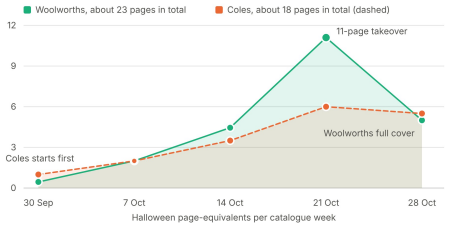
Halloween catalogue space per week, Coles vs. Woolworths, in page-equivalents (part pages counted as fractions of a page).Catalogues 30 September to 3 November 2026. Source: CROSSMARK catalogue data. n = 21 Coles pages and 25 Woolworths pages.
They spent their discounts in different places too. WW carried about twice the range of decorations, costumes and party supplies (about 76 products against 39) and cut their prices, from 50c off through to half-price costumes in Halloween week. Coles kept its decorations at everyday prices and put its weight behind treats. It ran Flybuys 10x points on Halloween confectionery for all five weeks, put chocolate sharepacks at half price, and had its own Halloween food range, from Ghoulish Ghosts chicken nuggets to 3D gummy eyeballs.
Brand partners followed the space. WW ran 6 advertiser pages to Coles’ 4. Cadbury and The Natural Confectionery Co. bought pages at both, M&M’s took full pages only at WW, and Duracell and M&S Food (Percy Pig) appeared only at Coles.
What it means for brands: the question isn’t just which retailer but which moment. WW sells one big week, and Coles sells a five-week run.
Same bag, bigger basket
Every trick-or-treater got the same $3.75 sharepack. Coles just packed a lot more around it, including something for the big kids.
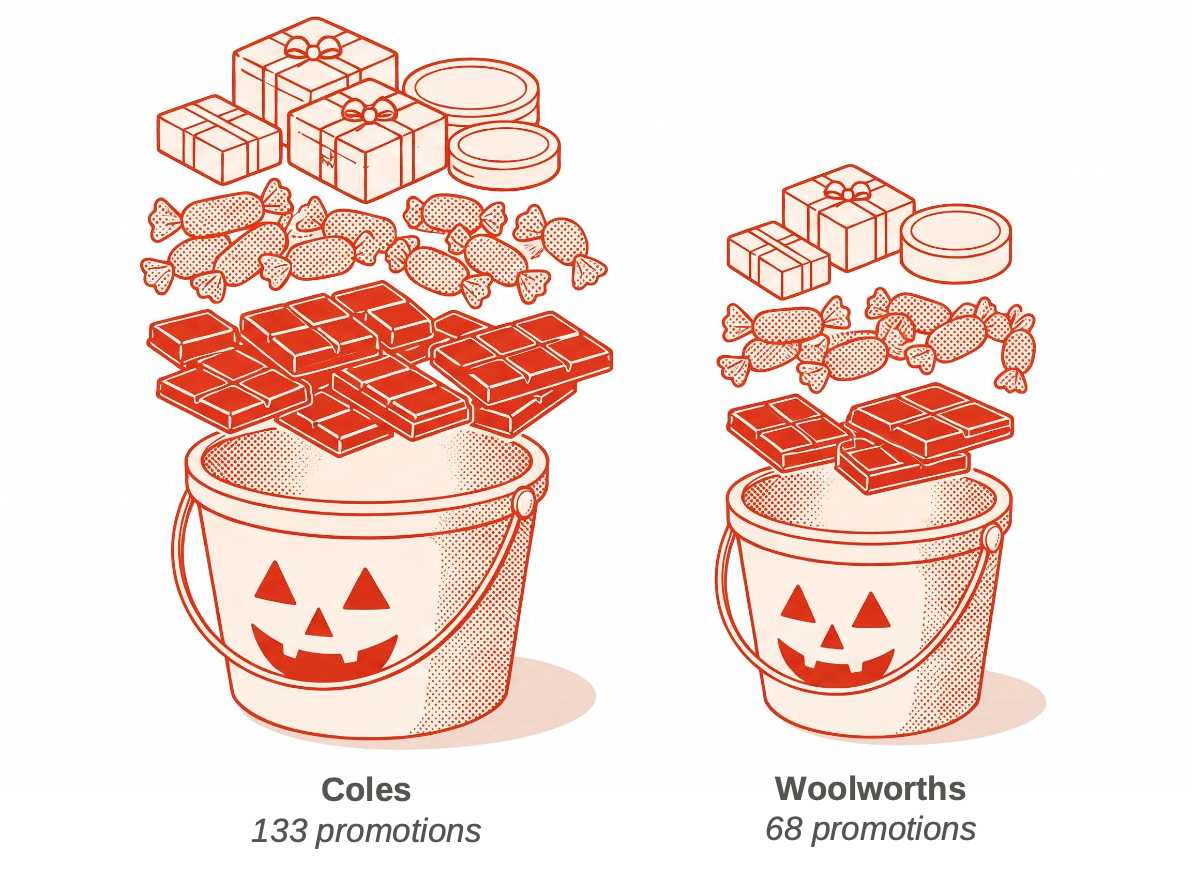
Who brought home the bigger haul? Confectionery products on promotion, Coles vs. Woolworths. Each piece = 2 promotions (rounded).
Catalogues 30 September to 3 November 2026. Source: CROSSMARK catalogue data. n = 133 Coles and 68 Woolworths promotions.
The trick-or-treat staple was identical on both sides of the street: fun-size sharepacks from Cadbury, Mars, Nestlé and The Natural Confectionery Co. were $3.75 at half price at both retailers, and the average discount was the same at both (45% where a retail price was shown). What changed was the size of the basket around them. Coles ran 133 confectionery promotions over the five weeks to Halloween against 68 at Woolworths, across 89 different products to Woolworths’ 50.
Coles also covered the big kids. Its Halloween pages carried gift boxes and tins (Ferrero Rocher and Raffaello, Toblerone, Roses, Celebrations, Maltesers and four sizes of Cadbury Favourites): 28 promotions against 6 at Woolworths, a little something for the grown-ups handing out the lollies. That lifted Coles’ average confectionery price to $5.70 against $4.58. Take the gift boxes out and the two sit almost level ($4.06 vs $3.91).
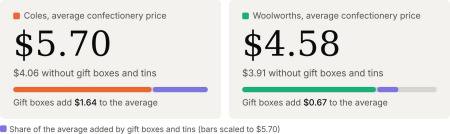
Average ticket price of confectionery on promotion, with and without gift boxes and tins, Coles vs. Woolworths. Multi-buy tickets excluded from the averages.
Catalogues 30 September to 3 November 2026. Source: CROSSMARK catalogue data. n = 133 Coles and 68 Woolworths promotions.
Woolworths filled its bag with lollies instead: they made up 47% of its confectionery promotions, against 28% at Coles. It had twice the Haribo (6 promotions to 3), plus Chupa Chups, Mentos and bulk bags like the Allen’s 1kg Party Pack, and about 1 in 5 of its confectionery sat at everyday low prices rather than on discount. Cadbury led at both (38% of Coles’ promotions, 32% of Woolworths’). Mars is the twist: Coles ran more Mars promotions (21 vs 9), but Mars spent its page money at Woolworths, with two full M&M’s pages.
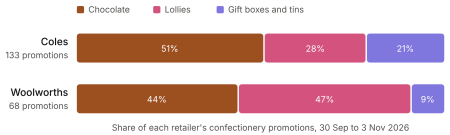
Share of confectionery promotions by type, Coles vs. Woolworths.
Catalogues 30 September to 3 November 2026. Source: CROSSMARK catalogue data. n = 133 Coles and 68 Woolworths promotions.
What it means for brands: the price of the core sharepack is set, so the battle is what goes in the bag around it. Coles is the stage for premium and gifting, Woolworths for lollies and bulk value, and a brand’s paid pages don’t have to follow where its promotions run.
Curry night vs. the Diwali pantry
Both supermarkets gave Diwali the same space but aimed at different shoppers: Coles set the table for curry night, while Woolworths stocked the South Asian pantry.
Both supermarkets gave Diwali (Sunday 8 November) about the same room, around 4 to 5 pages each across October and early November. That’s about a fifth of what Halloween got. How they used that room was very different, and each followed the same pattern it used for Halloween.
Coles ran a steady five-week “Celebrate Diwali” run (8 > 8 > 8 > 6 > 7 promotions a week) and kept repeating a core basket: its own-label naan was on 4 of the 5 pages, and 43% of its 37 Diwali promotions were everyday prices, not discounts.
Woolworths went big once. 13 of its 32 promotions landed in the week of 21 October across three pages, including an advertiser-funded “Diwali feast” page, and 81% were discounted (vs 57% at Coles).
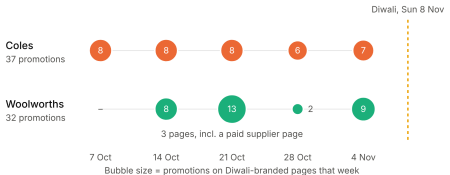
Promotions on Diwali-branded pages per week, Coles vs. Woolworths. Bubble size = promotions that week. Catalogues 7 October to 10 November 2026.
Source: CROSSMARK catalogue data. n = 37 Coles and 32 Woolworths promotions.
The baskets show who each retailer was talking to. Coles laid out the takeaway-at-home kit: breads and pappadams (10 promotions), plus jar sauces and meal kits from Patak’s, Sharwood’s and The Spice Tailor (30% of its Diwali promotions). Woolworths leaned into the staples and snacks of South Asian kitchens:
• six snack promotions against two at Coles: Haldiram’s aloo bhujia, Sunfeast Mad Angles, Mario masala noodles and Lay’s India’s Magic Masala
• paneer and ghee
• 5kg Alishaan basmati at half price
• fresh coconut and coriander
Nine brands appeared at both, and suppliers staggered their deals. Daawat ran the same $12.50 5kg basmati deal a week apart at each retailer, and Patak’s put four products into Woolworths’ Diwali week, two of them new launches.
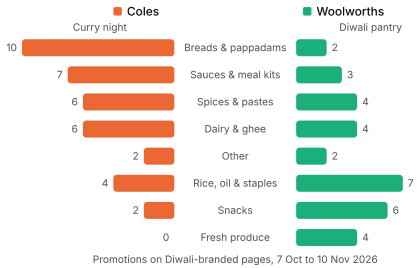
Products on promotion on Diwali-branded pages by type, Coles vs. Woolworths. “Other” is frozen samosas and sparklers at Coles, and a drink and a candle at Woolworths.
Catalogues 7 October to 10 November 2026. Source: CROSSMARK catalogue data. n = 37 Coles and 32 Woolworths promotions.
Diwali stays on its own pages, and Indian products barely featured anywhere else in either catalogue. But the section is growing. In the four weeks up to Diwali, Indian products on promotion rose from 25 last year to 45 this year (0.8% > 1.4% of all promotions), with early signs that Coles drove most of it (10 > 25). Many deals are now annual fixtures: Woolworths’ “40% off all Patak’s” came back in Diwali week at exactly last year’s prices.
What it means for brands: Diwali gets about a page a week, so placement is the contest. Mainstream curry brands fit Coles’ weekly curry-night slot, while specialist South Asian brands and snacks get more room in Woolworths’ one big week. The event is growing year on year while the deals stay the same, so there’s an opening for brands that bring something new instead of re-running last year’s offer.
What to expect from Black Friday
The supermarkets started three weeks early with one shared deal, and CE doubled its teaser and lowered its prices. The teaser is a good guide to which brands will show up in the main event.
Grocery: same deal, same suppliers, three weeks early
Black Friday falls on 27 November, but it arrived in supermarket catalogues from 4 November, and Coles and Woolworths both used the same mechanic: “Better than ½ Price” on personal care and household products. Coles kept it tight at 9 products, all 53–61% off. Woolworths ran 18, and also gave two full Black Friday pages to app and online codes with no products on them at all: $15 off a $150 app order, $30 off a first online shop, and “up to 50% off” online-only specials. Woolworths’ Black Friday is as much about getting shoppers to order online as it is about price.
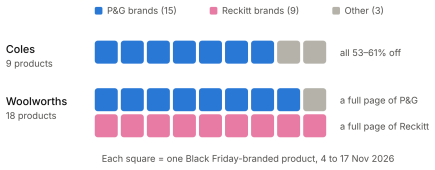
Black Friday-branded products on promotion by brand owner, Coles vs. Woolworths. One square per product. Catalogues 4 to 17 November 2026. Woolworths’ third-party marketplace pages are excluded. Source: CROSSMARK catalogue data. n = 9 Coles and 18 Woolworths products.
Look at whose products were on promotion and it’s largely a two-supplier event. 15 of the 27 Black Friday products came from P&G brands and 9 from Reckitt.
• Coles: 7 of its 9 products were P&G (Oral-B, Pantene, Gillette).
• Woolworths: gave each supplier its own page: 8 P&G products (Olay, Head & Shoulders, Oral-B, Gillette) and 9 Reckitt cleaning products (Finish, Dettol, Glen 20, Pine O Cleen, Vanish).
CE: a bigger, more affordable teaser
The early Black Friday teaser in CE doubled to 226 products (from 113 last year), across 28 pages instead of 16, and moved down to mid-priced products:
• half of products now sit between $100 and $499 (up from 29%)
• products over $1,000 halved to 13%
• the median price fell from $599 to $384
November’s release calendar planned CE’s Black Friday for it. With GTA VI, the new Zelda and the Switch 2 all landing in the run-up, gaming went from an afterthought to a front-of-catalogue draw. This year’s teaser carried 25 gaming products against 5 last year, almost all consoles, controllers and headsets: the gear shoppers need before the big titles arrive.
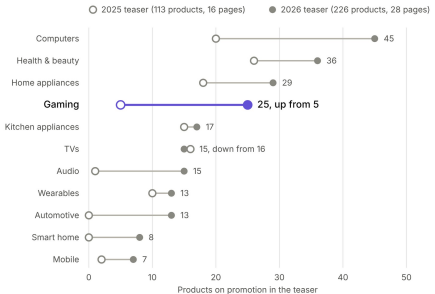
Products on promotion in the early Black Friday teaser in CE by category, 2025 vs. 2026, with gaming highlighted. The 2026 teaser ran to 28 pages against 16 in 2025.
Source: CROSSMARK catalogue data. n = 113 (2025) and 226 (2026) products.
What comes next
Going by last year, the teaser shows which brands and categories will be in the main event, but not the full range. 35 of last year’s 36 teaser brands, and every teaser category, came back for the main event, but only 41% of teaser products did. 43 of the 46 that returned were at exactly the same price. The main event then added audio, phones, smart home, cameras and media. This year’s teaser already looks more like last year’s main event, led by Lenovo, HP, ASUS and Google. Expect the same brands with a wider range, and little reason for shoppers to wait in case teaser deals get cheaper.
What it means for brands: Black Friday is now a season of three to four weeks, not a single day, and the early slots are where the decisions get made. In grocery, the “Better than ½ Price” spots went to two suppliers, and retailers are steering shoppers to their apps. In CE, being in the teaser is a strong sign of a place in the main event, and the teaser price is in practice the Black Friday price.
Stay across our insights
At CROSSMARK, we work with a broad mix of retail data, field intelligence, and FMCG category experience across the business. That gives us a practical view of what is happening in-store, online, across catalogues and at the point of decision, helping us shape better strategies and deliver stronger outcomes for our clients.
This article is part of an insights series where we’ll be sharing different reads on channels, categories, and shopper behaviour throughout the year. If you’d like these sent straight to your inbox, you can sign up to the CROSSMARK newsletter. And if anything here sparks a thought, challenge or opportunity for your brand, please feel free to reach out.